Rotterdam-based
start-up Wattlab has enjoyed some well-deserved successes recently with its
innovative Solar Flatrack solution – the first solar-power system to compensate
the hotel load on ships, engineered specifically for seagoing cargo vessels.
Boldly
going where no one has gone before
The
Wattlab story begins eight years ago when founders Bo Salet, David Kester, and Sieber
Roefs were studying at the Delft University of Technology (TU Delft). Bo was
studying Space Engineering – which goes some way to explaining the large model
rocket displayed in his office.
“I
got that during my graduation project,” he explains. “It’s a sort of
progression meter. I broke my project down into five sections, and every time I
completed one, I allowed myself to add a layer. I symbolically added the tip
during my final presentation.”
The
three colleagues met while participating in the Nuon Solar Team, a student
project to construct – and race – a solar-powered car.
“We
had a lot of fun. After that, none of us was satisfied with our studies alone.
We wanted another challenge. So, we said, ‘let’s start something’.”
To
begin with they developed a lightweight solar panel and set out to identify
companies for which they thought there may be a business case.
“We
looked at everything from art to space to building facades to trucks,” he says.
Following
an introduction to hatch manufacturer Blommaert Aluminium, Wattlab began to
produce solar systems for inland shipping – today there are in the region of 30
vessels sailing with their solutions, thanks to this collaboration.
From
rivers to oceans
Soon
though, Bo continues, the team began to see the potential of solar power in
supporting the short sea sector in its bid for increased sustainability and
efficiency.
The
result was the development of Solar Flatrack. Since then, the system has been
tested – and proven – in a series of pilot projects, and verified by TNO – the
Netherlands Organisation for Applied Scientific Research.
In
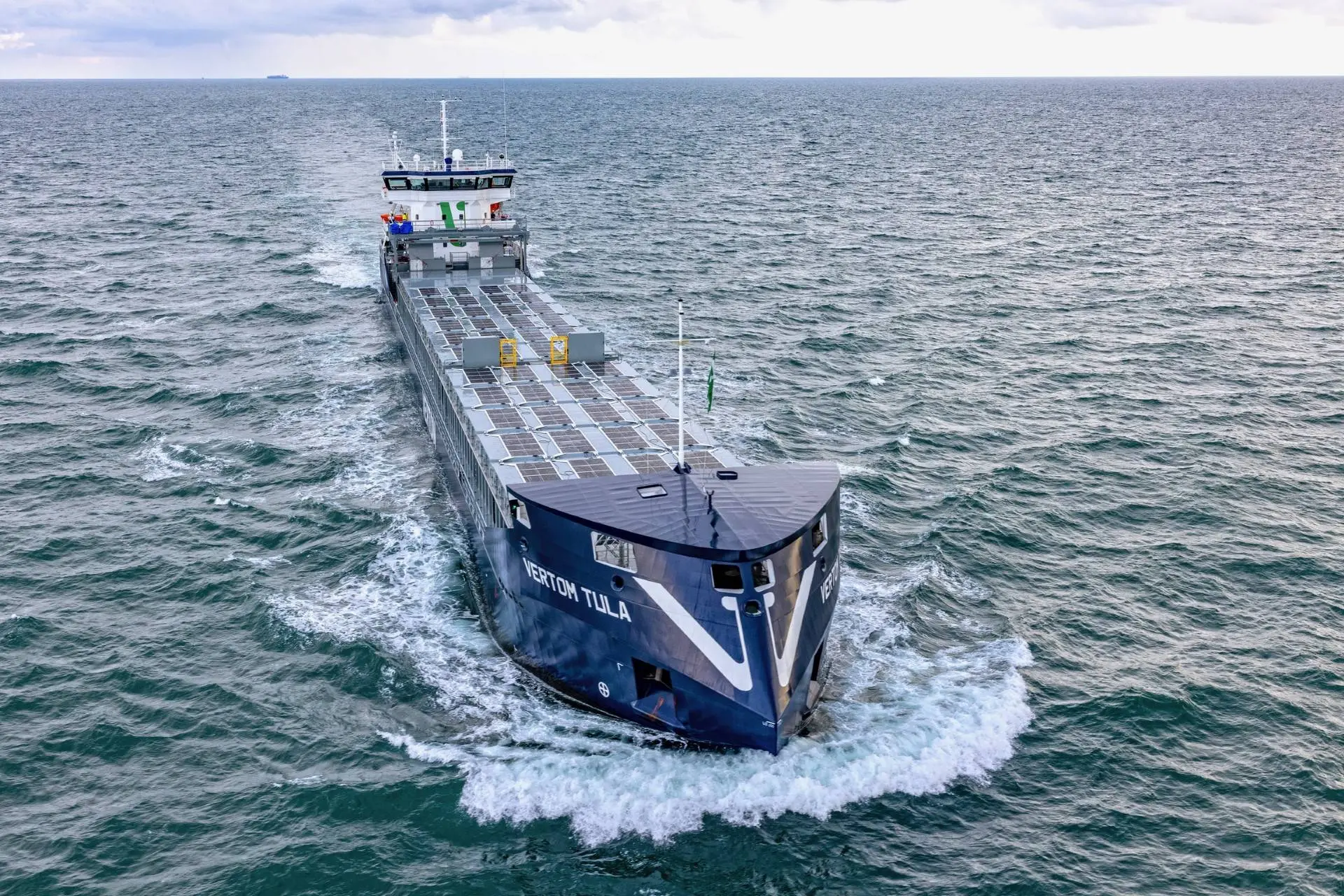
one of the pilot projects, a Solar Flatrack system was installed onboard MV
Vertom Tula. The first seagoing vessel to be equipped with the solar system features
a 79 kWp installation. The system reduces the load on the vessel’s grid
connectors and diesel generators, improving fuel efficiency and freeing up
additional power for propulsion and onboard operations.

Compliance
companion
While
the primary benefits of the Solar Flatrack are easily explained – a reduction
in fuel consumption and emissions – there are a lot more benefits on offer, Bo
states.
“For
one thing – and particularly relevant for short sea applications at the present
time – Solar Flatrack helps operators to comply with regulatory requirements
such as the Carbon Intensity Indicator (CII), Energy Efficiency Existing Ship
Index (EEXI), EU ETS and FuelEU Maritime.
“Additionally,
if there is a battery on board, adding solar power to the mix will lower the number
of cycles, thereby extending the lifecycle of an expensive component.”
The
system also requires very little maintenance. Bo explains that it can be
straightforwardly cleaned along with the rest of the deck – either using water
or detergent.
Wattlab
has taken care to develop a system that can endure the harsh operating
conditions required of a seagoing maritime application.
“We’ve
used components that are proven in use for the long-term and made sure that
vulnerable, expensive parts are durable, while parts that are likely to face
wear or damage can be easily repaired or replaced by crew.”
Managing
misconception
Despite
the rapid success of Solar Flatrack, Bo explains that there are still
challenges to be overcome as Wattlab sets about positioning the system in the
market.
“Sometimes
we see that vessel operators assume that they need to remove the system each
time they load or unload – which I understand would raise concerns, but it
isn’t the case. The system is easily installed, within a few hours using the
vessel’s hatch crane. Once it’s in place, you can leave it there and continue
normal operations.”

However,
he continues, the system can just as easily – and swiftly – be removed in the
event an operator wishes to transport a deck load.
“The
pieces are designed to be stacked, one on top of the other, forming the same
footprint as a standard shipping container. They can just be secured in place
and the rest of the space used to carry cargo.”
Another
challenge is finalising the class regulations surrounding use of Solar Flatrack.
“Given
that this is the first time that such a system has been used onboard seagoing
vessels, there is a bit of a grey area surrounding classification requirements
– as there is with any new technology.
"We've
been in contact with the classification societies from the start. We're
collaborating together to develop the Approval in prinicple."
The
future of short sea
Recently,
as covered on Short Sea News, Wattlab has signed a contract with
Norwegian company Berge Rederi, to install a system on BRF Froan – which, when
delivered later this year, will be the world’s first fully electric bulk
carrier.
“It’s
a very exciting project,” says Bo. “As an engineer I look forward to the
technical challenge involved. And also, this is a chance to really show what we
can do – this vessel represents the future of short sea shipping.”
Popular news
Latest Comments
Loading