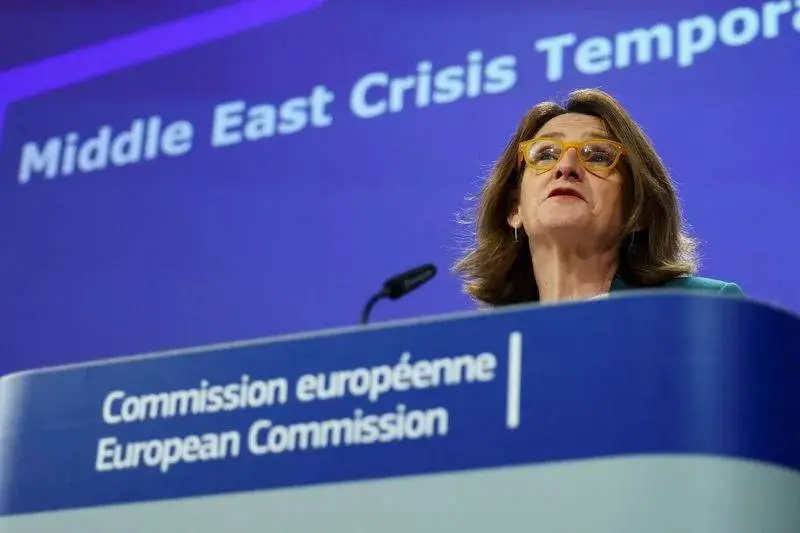
Achieving a clean economy is what will shield us from the energy crises of the future. The energy transition remains the most effective strategy for Europe’s autonomy, growth and resilience. Nevertheless, the recent spikes in energy prices require an immediate response. The METSAF allows for easily applicable solutions that will sustain the continuous development of core EU sectors such as agriculture, fishery and transport, by cushioning the effects of the crisis.- Teresa Ribera, Executive Vice-President for Clean, Just and Competitive Transition
The European Commission has adopted a temporary State aid framework to enable Member States to support the EU economy in the context of the Middle East crisis. The Middle East crisis Temporary State aid Framework (METSAF) is a targeted and temporary framework to address the effects of the crisis on some of the most exposed sectors of the economy: agriculture, fishery, transport and energy-intensive industries. The METSAF will be in place until 31 December 2026. During its period of application, the Commission will keep the content, scope and duration of the Framework under review in the light of developments in the Middle East and in the general economic situation.
While the transition towards a clean economy remains the long-term solution to shield EU companies from the effects of global energy shocks, the METSAF allows Member States to act immediately to make sure that the growth of the most exposed companies is not irreparably hampered by the current crisis.
To this end, support can take various forms for companies active in the agriculture, fishery and transport sectors. This includes aid based on actual consumption to cover part of the price increases for fuel or fertilisers, and a simplified approach for small amounts of aid.
The METSAF also includes a temporary adjustment to the Clean Industrial Deal State aid Framework (CISAF) allowing for further flexibility and higher aid intensities to address electricity price spikes.
Specifically, the framework allows for the following:
- For agriculture, fishery, land transport (road, rail and inland waterways) and intra-EU short sea shipping, Member States will be able to compensate up to 70% of a beneficiary's extra costs due to the price increase of fuel and fertiliser caused by the crisis. The price increase will be determined by each Member State by looking at the difference between the relevant market price and an applicable historical benchmark price. The total extra costs will then be calculated based on the beneficiary's current or latest pre-crisis consumption.
- For these sectors, a simplified option will make it easier for beneficiaries to qualify for the aid. It allows Member States to calibrate individual aid amounts on elements like the size and type of beneficiaries' activities, a general estimate of fuel consumption in the sector, or other relevant proxies, rather than beneficiaries having to provide detailed proof of their actual consumption. Under this option, each beneficiary can receive up to €50,000.
- For energy-intensive industries eligible under temporary electricity price relief schemes in line with section 4.5 of the CISAF, it will be possible to increase the aid intensity from 50% to up to 70% for the electricity cost of the eligible consumption. This can cover up to 50% of the total consumption of the beneficiary. No additional increase in decarbonisation efforts will be required. A cumulation with aid granted under the ETS State aid Guidelines will be possible for up to half of the aid amount granted under Section 4.5 CISAF schemes.
Measures under the METSAF will have to be notified to the Commission. The framework will allow for a fast approval process.
The Commission stands ready to assess, on a case-by-case basis and subject to several requirements, temporary measures that may include subsidising the fuel cost of gas-fired electricity generation to reduce overall electricity costs.
Image by Yves Herman for Reuters in Brussels
Popular news
Latest Comments
Loading