Last Thursday, 5th March, Short Sea News
attended the Institute of Chartered Shipbrokers (ICS) Netherlands Branch’s
meeting in Groningen. The first of the branch’s events to be held in the north
of the country was titled Perspectives on the Short Sea Shipping Market. The
meeting attracted over 70 delegates, including vessel owners, banks, P&I
clubs, tax advisors, funds and shipbrokers.
As media partner for the event, Short Sea
News delivered a short presentation introducing our news site and calling on
delegates to share their news and opinions with us. Following this it was time
a presentation from Sea3R founder and regular Short Sea News columnist Peter
Molloy.
Using data from Sea3R’s new portal, and an
assortment of informative graphs, Peter demonstrated the latest developments in
the European gearless coaster fleet. As he reported on Short Sea News recently,
asset values continue to decline across the four categories of vessels – 3600,
5000, 6500 and 8500 DWT – that Sea3R analyses.

Peter Molloy presents the latest findings from Sea3R's new portal
As the graphs made abundantly clear,
however, recent declines have followed historical highs a few years ago, largely
related to coasters picking up work during a shortage of container vessels, and
are an inevitable correction.
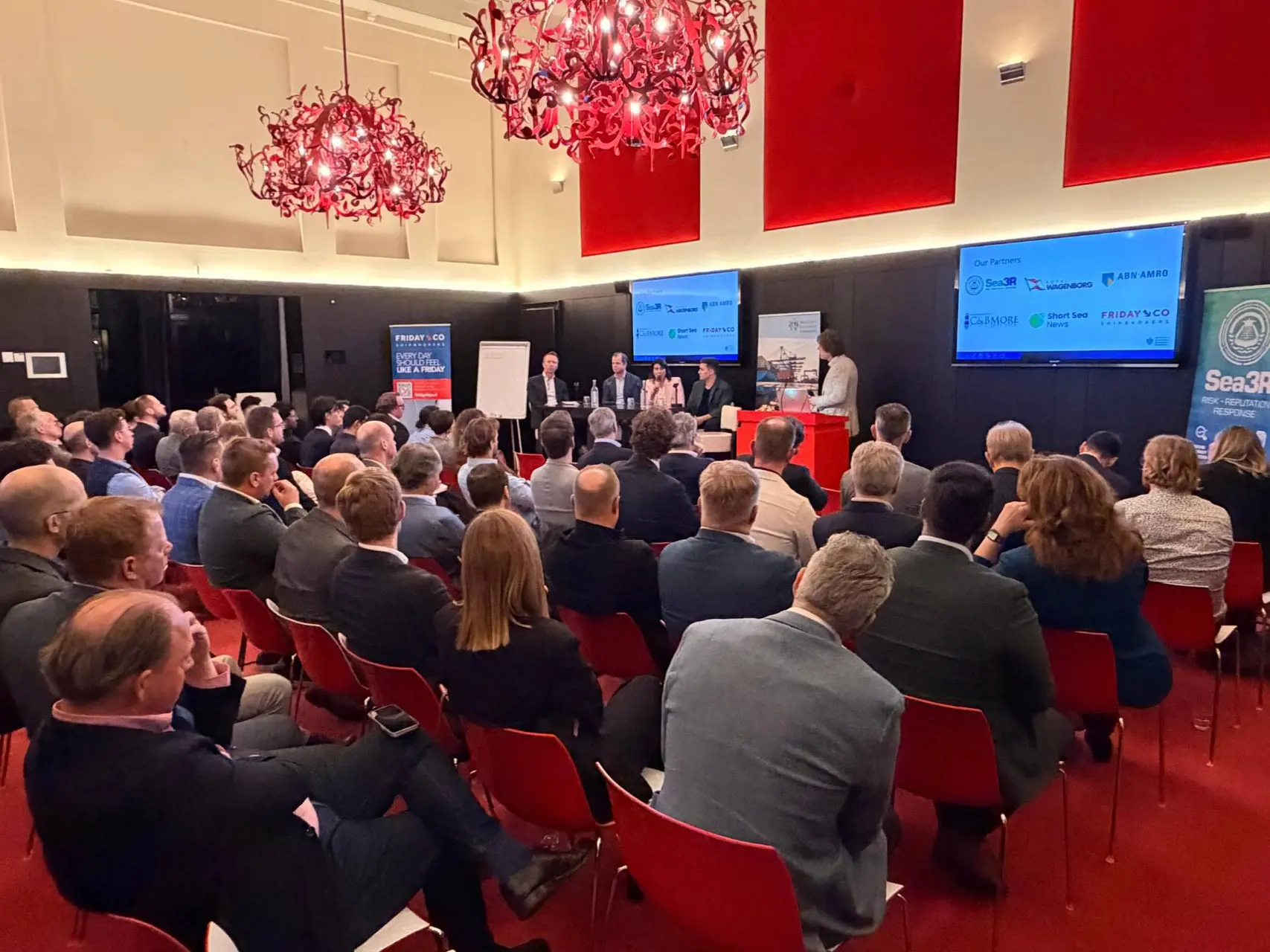
Following this, a panel featuring Peter,
Jacko Boorsma (Royal Wagenborg), Floris C. S. Arts (ABN Amro), Connie Roozen
(C&B More), and moderated by Roderick Schlick (Friday & Co.
Shipbrokers) sat to discuss the state of the sector. The panellists considered
a wide range of topics, including the challenges of fleet renewal,
environmental regulations and geopolitics.

The panel discussed the wide-ranging challenges facing the sector at present
There were clear indications that high
newbuilding costs were not the only barrier to placing an order at the present
time, with operators waiting for further clarity on the future fuel scenario
before committing to long-term investments.
This is not the only impact of the drive
for increased sustainability on newbuild orders – another example is the high
number of orders placed for vessels that fall just below the 5000 GT threshold
of the EU ETS regulations. At this, Jacko Boorsma indicated Royal Wagenborg’s
support for a wider roll-out of the regulations in order to provide a more
level playing field.
As the panel discussion made clear, the
costs of compliance are having quite an impact on operators – leading, as
Connie Roozen stated, to calls to ensure that the money generated by ETS are
directed back into the sector.
Not only costs, but also the increased
administrative burden, are having a considerable effect – most notably smaller
businesses, who are finding access to finance more challenging, an
area that Floris Arts made clear was not the focus for the banks at present.
The financial implications of this for the
smaller operators led the panel to consider whether we might expect to see more
consolidation, as smaller, struggling companies are acquired by larger ones
better positioned for the challenge.
Views were mixed, but the Sea3R data
indicates little sign of this taking place presently. Additionally, with a
large portion of tonnage at an advanced age, many smaller fleets are unlikely
to meet the efficiency requirements of larger companies. As a result, we may
see increased rates rather than significantly higher levels of consolidation.
A further topic that was touched on by the
panel was crewing challenges. It was interesting to note that this is leading
operators – certainly in the case of Royal Wagenborg – to seek personnel in new
locations. The company is, for example, recruiting seafarers from Peru where,
thanks to the country’s extensive coastline, the required experience is to be
found.
Where there was consensus among the
panellists was the challenge posed by the current geopolitical climate –
especially given recent events in Iran. However, as those dramatic spikes in
asset values seen on the Sea3R graphs ably demonstrated, sometimes short sea
benefits in the face of conventional routes breaking down.
In our mission to gather and report on news
and topics affecting the sector, Short Sea News is keen to attend – and cover –
more industry events. If you have something planned and you would like us to
report on it, please get in touch.
Popular news
Latest Comments
Loading